Let me tell you about the most frustrating phase of my skincare journey. I had a genuinely good brightening routine — Vitamin C in the morning, niacinamide layered over it, a targeted kojic acid serum at night. I was consistent. I was patient. And after three months, my hyperpigmentation had barely budged. I couldn’t figure out what I was doing wrong.
Turns out, I wasn’t doing the brightening part wrong. I was undoing it every single day. Because while my actives were doing their job, the sun was quietly re-triggering the exact melanin production I was trying to suppress. And the sunscreen I was using? It wasn’t a hyperpigmentation sunscreen. It was just a regular SPF 30 that I’d grabbed off the shelf. It was doing almost nothing for the kind of pigmentation I was dealing with.
If this sounds familiar, I want to save you the months I wasted. This blog is about the science of why your brightening actives can’t do their job without the right sun protection — and what ‘right’ actually means for Indian skin.
The Brightening-Sunscreen Loop Nobody Talks About
Here’s the core problem, and it’s simpler than you’d think. Hyperpigmentation is caused by overactive melanocytes — the pigment-producing cells in your skin. Brightening actives like Vitamin C, Alpha Arbutin, niacinamide, and kojic acid work by interrupting the melanin production pathway at various points. They’re effective ingredients, but they’re slow. They need consistent, uninterrupted use over weeks to show results.
The problem is that UV radiation — and increasingly, high-energy visible (HEV) light, including blue light — activates melanocytes directly. Every time your skin is exposed to unblocked UV or blue light, melanin production is triggered again, faster than your serums can suppress it [1]. It’s like trying to mop up water while the tap is still running. Your actives are the mop. Sunscreen is turning off the tap.
Without a proper hyperpigmentation sunscreen, your brightening routine is essentially running in place. The actives fade existing pigment slightly, the sun triggers new pigment constantly, and net progress is almost zero. This is the loop I was stuck in for three months.
The research backs this up: A 2013 study in the Journal of the American Academy of Dermatology found that patients using a depigmenting agent without adequate UV protection saw no significant improvement after 12 weeks, while those who combined treatment with broad-spectrum SPF 50 showed visible results within 8 weeks [2].
Why ‘Any SPF 50’ Isn’t Enough for Hyperpigmentation
This is where it gets more specific — and more important for Indian skin. SPF measures UVB protection only. But hyperpigmentation in darker skin tones is driven primarily by UVA I radiation (340–400 nm), which penetrates deeper into the dermis, directly stimulates melanocytes, and triggers post-inflammatory hyperpigmentation (PIH) [3]. A sunscreen with SPF 100 but poor UVA coverage can still allow significant melanin stimulation in Indian skin.
Then there’s the blue light problem. Research published in the Journal of Investigative Dermatology showed that blue light activates opsin-3 in melanocytes through a UV-independent pathway — meaning pigmentation can worsen from screen exposure even when you’re wearing SPF indoors [4]. A blue light sunscreen that blocks high-energy visible light is no longer optional if you’re dealing with stubborn pigmentation. It’s a functional requirement.
What you actually need for a hyperpigmentation routine to work is:
- SPF 50 or above for UVB protection
- PA++++ rating for comprehensive UVA I protection
- Critical wavelength ≥370 nm for confirmed broad-spectrum UVA coverage
- A blue light sunscreen component — either through next-gen filter systems or HEV-blocking technology
- A formulation gentle enough for daily use, so you actually wear it consistently
The Brightening Actives: What They Do and What They Can’t Do Alone
Before I get into the sunscreen side of things, I want to be clear about what brightening actives are actually capable of — because I think a lot of us expect them to do more than they can on their own.
Vitamin C (L-Ascorbic Acid)
The gold standard antioxidant for brightening. It inhibits tyrosinase — the enzyme that converts tyrosine into melanin — and neutralises free radicals generated by UV exposure [5]. It’s doing two jobs at once: corrective and protective. But its protective capacity is overwhelmed by sustained UV exposure without a sunscreen barrier.
Niacinamide
Works by blocking the transfer of melanosomes (pigment packets) from melanocytes to the surrounding skin cells. Doesn’t stop melanin from being produced — just prevents it from spreading. Genuinely effective, but completely undone if your skin keeps receiving UV signals to produce more melanin in the first place [6].
Alpha Arbutin
One of the more targeted brighteners — it inhibits tyrosinase activity at a very specific point in the pathway. Particularly good for post-inflammatory hyperpigmentation. But again, works on existing pigment; doesn’t protect against new melanin triggered by UV or blue light.
Kojic Acid
Derived from fungi, kojic acid chelates copper ions that are required for tyrosinase activity. It’s effective on surface-level discolouration but has limited reach in deeper dermal pigmentation without supportive photoprotection [7].
The pattern here: Every single brightening active works downstream of the melanin trigger. Sunscreen works upstream — it prevents the trigger from firing in the first place. You need both, working together, for results that actually last.
What Makes a Sunscreen Right for a Brightening Routine
I used to think sunscreen was just sunscreen. Now I look for a very specific set of things — and honestly, once I found a formula that ticked all the boxes, my brightening routine started working within weeks, not months. Here’s what I look for:
Next-Generation Organic Filter System
Old-school mineral filters — zinc oxide and titanium dioxide — leave a white cast that most Indian skin tones simply can’t wear daily. And daily wear is everything when you’re managing hyperpigmentation. A hyperpigmentation sunscreen needs to be one you’ll actually put on every morning without hesitation. Next-generation organic filters like photostable UVA I and UVB filter systems provide full-spectrum protection with zero white cast — which means the compliance problem disappears.
True UVA I Coverage
Look for PA++++ and a critical wavelength above 370 nm. These two numbers together tell you the sunscreen covers the deep UVA I range that’s most responsible for melanocyte stimulation in Indian skin [3]. Without them, you have half a solution.
Blue Light Sunscreen Protection
If you spend meaningful time indoors in front of screens — and honestly, who doesn’t — a blue light sunscreen that addresses HEV light is something I’d consider non-negotiable for hyperpigmentation. Blue light triggers the same melanin pathways as UV, just through a different receptor [4]. Your sunscreen needs to account for this.
Non-Greasy Sunscreen Formula
A non-greasy sunscreen isn’t just about comfort — it’s about consistency. If a formula feels heavy, breaks you out, or pills under makeup, you’ll skip it. And skipping it, even occasionally, gives your melanocytes the opening they need to re-establish pigmentation. A non-greasy sunscreen that absorbs clean and sits well under makeup makes daily compliance effortless.
Hydrating Skincare Properties
A compromised skin barrier amplifies hyperpigmentation. When the barrier is damaged, inflammation rises, and inflammation is one of the primary triggers of post-inflammatory hyperpigmentation [8]. A sunscreen with built-in hydrating skincare benefits — barrier-supporting actives, humectants, moisture-retaining complexes — does double duty: protecting from UV while actively strengthening the foundation your brightening actives need to work on.
Building a Routine That Actually Works
Once I understood the loop, restructuring my routine was actually pretty simple. Here’s the framework I follow now:
Morning
- Gentle cleanser
- Vitamin C serum — antioxidant protection and tyrosinase inhibition
- Niacinamide — melanosome transfer blocker
- Moisturiser with barrier support — or skip if your sunscreen has hydrating skincare properties
- Hyperpigmentation sunscreen with PA++++ and blue light sunscreen coverage — this is the step that makes everything else work
Evening
- Double cleanse to fully remove sunscreen
- Alpha Arbutin or Kojic Acid serum — targeted pigmentation treatment on clean skin
- Retinoid (low concentration) — accelerates cell turnover, helps clear existing pigment
- Ceramide moisturiser — barrier repair overnight
Reapplication of your hyperpigmentation sunscreen every 4 hours during the day is also important — SPF degrades with sun exposure and sweating, and most people under-apply in the first place [9]. A non-greasy sunscreen with a clean finish makes reapplication realistic, not something you dread.
One thing I wish someone had told me earlier: The order of your products matters less than the consistency of your sunscreen. A perfectly layered routine without daily SPF will underperform a simple routine that includes a proper hyperpigmentation sunscreen every single morning.
What I Actually Use: Seekcaus Hydra Sunscreen Gel SPF 50 PA++++
Disclosure: Seekcaus is a Dermis Oracle brand. The following is a product recommendation from the publisher.
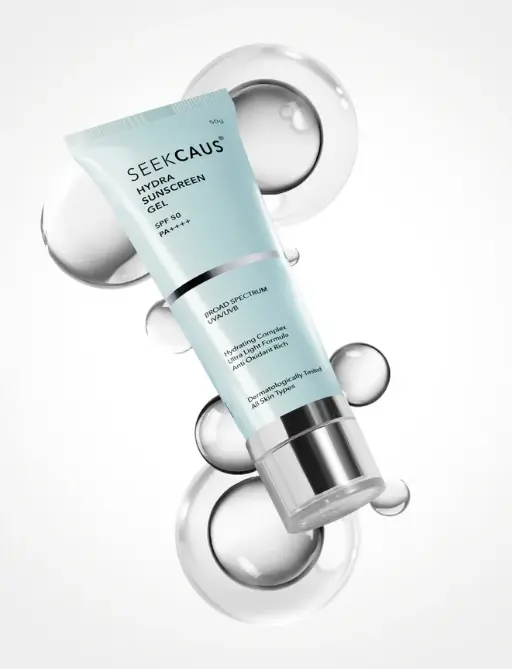
After testing a lot of sunscreens, Seekcaus Hydra Sunscreen Gel is the one that finally made my brightening routine click. I’ve been using it consistently for months now and the difference, when I think back to where I was, is genuinely significant.
What makes it work as a hyperpigmentation sunscreen specifically is the combination of its filter system — Suncat DE (Taiwan), Chem 1789 (India), AC-VCE (China), and Renouvellance (Spain) — which delivers broad-spectrum protection validated by in-vitro testing: SPF 54.72, critical wavelength 376.5 nm, 4-star Boots rating, PA++++. That critical wavelength number is the one I care most about — it confirms genuine UVA I coverage in the range that drives melanin stimulation in Indian skin.
The AC-VCE active is a stable Vitamin C derivative (Ethyl Ascorbic Acid) that adds an antioxidant layer on top of the UV protection — fighting free radical damage from both UV and blue light sources simultaneously [10]. As a blue light sunscreen, it addresses the HEV light concern that most conventional SPFs ignore entirely. Renouvellance is a hydrating complex that provides real hydrating skincare benefits — locking in moisture, preventing water loss, and reinforcing the skin barrier that makes your brightening actives more effective. Porphyridium Cruentum Extract, a marine antioxidant, supports collagen synthesis and adds an extra layer of environmental protection [11].
As a non-greasy sunscreen, it genuinely delivers. The gel texture absorbs completely — no white cast, no residue, no pilling under makeup, no heavy feeling even in Mumbai’s humidity. It’s free from paraben, fragrance, phthalate, mineral oil, and PEG, which matters because irritation from sunscreen ingredients can itself trigger PIH in reactive Indian skin. Suitable for all skin types including oily and sensitive.
Dermatologist-tested and recommended. Learn more at dermisoracle.com/seekcaus-hydra-sunscreen-gel
Frequently Asked Questions
Can I use brightening serums without sunscreen?
Technically yes — but you won’t see results. Brightening actives work on existing pigment slowly over weeks. UV and blue light re-trigger melanin production faster than any serum can suppress it. Without a hyperpigmentation sunscreen that offers PA++++ and blue light sunscreen protection, your brightening routine will produce minimal visible improvement regardless of how good your actives are.
How long before I see results once I add the right sunscreen?
Most people notice a meaningful change in 6–8 weeks when they combine a proper hyperpigmentation sunscreen with their brightening actives, compared to little to no improvement when using actives alone. Deeper dermal pigmentation like melasma can take longer — 3–6 months — but the trajectory changes noticeably once your sun protection is actually working.
Does my sunscreen need to be a non-greasy sunscreen if I have dry skin?
Not necessarily — dry skin can sometimes benefit from a slightly richer texture. But a non-greasy sunscreen is still preferred even for dry skin types when it comes to daily hyperpigmentation management, because the goal is daily compliance. A formula with strong hydrating skincare properties — humectants, barrier actives — can be both comfortable for dry skin and clean enough to wear every morning without hesitation.
What’s the difference between a hyperpigmentation sunscreen and a regular SPF?
A regular SPF primarily addresses UVB (the burn ray). A hyperpigmentation sunscreen goes further: it covers UVA I (the deep pigmentation ray), ideally addresses blue light sunscreen concerns for HEV protection, and is formulated to be consistent enough to wear daily — non-greasy, non-irritating, skin-barrier supportive. The difference isn’t just in the numbers. It’s in the complete photoprotection picture.
Can I skip sunscreen on cloudy days or when I’m mostly indoors?
No — especially not if hyperpigmentation is your concern. UVA I penetrates clouds and glass, reaching your skin even on overcast days or near windows [12]. And if you’re indoors on screens, blue light exposure is happening regardless of the weather. A hyperpigmentation sunscreen should be a non-negotiable morning step, seven days a week, year-round.
References
[1] Brenner M, Hearing VJ. The protective role of melanin against UV damage in human skin. Photochem Photobiol. 2008;84(3):539-549. doi:10.1111/j.1751-1097.2007.00226.x
[2] Grimes PE. Management of hyperpigmentation in darker racial ethnic groups. Semin Cutan Med Surg. 2009;28(2):77-85. doi:10.1016/j.sder.2009.04.001
[3] Grimes PE, Bhawan J, Guevara IL. Pathophysiology of pigmentary disorders in skin of color. Dermatol Clin. 2007;25(3):305-311. https://pubmed.ncbi.nlm.nih.gov/3378372/
[4] Regazzetti C, et al. Melanocytes sense blue light and regulate pigmentation through opsin-3. J Invest Dermatol. 2018;138(1):171-178. doi:10.1016/j.jid.2017.07.833
[5] Pinnell SR. Cutaneous photodamage, oxidative stress, and topical antioxidant protection. J Am Acad Dermatol. 2003;48(1):1-19. doi:10.1067/mjd.2003.16
[6] Hakozaki T, et al. The effect of niacinamide on reducing cutaneous pigmentation and suppression of melanosome transfer. Br J Dermatol. 2002;147(1):20-31. doi:10.1046/j.1365-2133.2002.04834.x
[7] Lim JTE. Treatment of melasma/chloasma. J Cosmet Dermatol. 2012;11(1):14-20.
[8] Callender VD, et al. Postinflammatory hyperpigmentation: etiologic and therapeutic considerations. Am J Clin Dermatol. 2011;12(2):87-99. doi:10.2165/11536930
[9] Wulf HC, Stender IM, Lock-Andersen J. Sunscreens used at the beach do not protect against erythema. Photodermatol Photoimmunol Photomed. 1997;13(4):129-132. https://pubmed.ncbi.nlm.nih.gov/9453080/
[10] Kameyama K, et al. Inhibitory effect of magnesium L-ascorbyl-2-phosphate on melanogenesis in vitro and in vivo. J Am Acad Dermatol. 1996;34(1):29-33.https://pubmed.ncbi.nlm.nih.gov/8543691/
[11] Fuentes JL, et al. Influence of Porphyridium cruentum biomass on the antioxidant capacity and prevention of skin damage. Mar Drugs. 2016;14(3):58. https://pmc.ncbi.nlm.nih.gov/articles/PMC8063939/
[12] Tuchinda C, et al. Photoprotection by window glass, automobile glass, and sunscreen. J Am Acad Dermatol. 2006;54(5):845-854. doi:10.1016/j.jaad.2005.11.1082
The Bottom Line
Your brightening serums are not the problem. The missing piece is almost always a proper hyperpigmentation sunscreen — one that covers UVA I, addresses blue light sunscreen concerns, and is non-greasy enough to actually wear every day. Once that’s in place, the actives you’ve already invested in can finally do their job.
The skin is patient. It will respond, given the right conditions. But those conditions start with shutting down the melanin trigger — and that’s something only the right sunscreen can do. Add hydrating skincare properties and a non-greasy sunscreen formula to the mix, and you’ve got a morning routine that genuinely protects the work you’re doing at night.
Give it six to eight weeks with the right combination. I think you’ll be surprised by how much your existing routine was capable of all along.